If you’ve just started learning about the Indian stock market, you’ve probably heard people say things like, “The Nifty is up today,” or “The Sensex fell by 300 points.” But what do these terms actually mean?
Nifty 50 vs Sensex: What Every Beginner Should Know
The stock market has two names that you’ll hear almost every day—Nifty 50 and Sensex. But are they the same? Which one matters more to investors? And which should beginners follow?”
If you’ve recently started learning about investing in India, you’ve probably seen headlines like:
- “Nifty closes above 24,000.”
- “Sensex gains 600 points today.”
These numbers may seem confusing at first, but they are actually one of the easiest ways to understand how the Indian stock market is performing.
In this beginner-friendly guide, you’ll learn:
- What Nifty 50 is
- What Sensex is
- The differences between them
- How they are calculated
- Which index is better for beginners
- Common myths and FAQs
Let’s start with the basics.
What Is a Stock Market Index?
A stock market index is a collection of selected stocks that represents the performance of a particular group of companies.
Think of it like the report card of the stock market.
Instead of checking thousands of listed companies individually, investors simply look at an index to understand whether the market is rising or falling.
For example:
- If most large companies are gaining in value, the index rises.
- If many companies are losing value, the index falls.
This makes indices one of the most important tools for investors, analysts, and policymakers.
What Is Nifty 50?
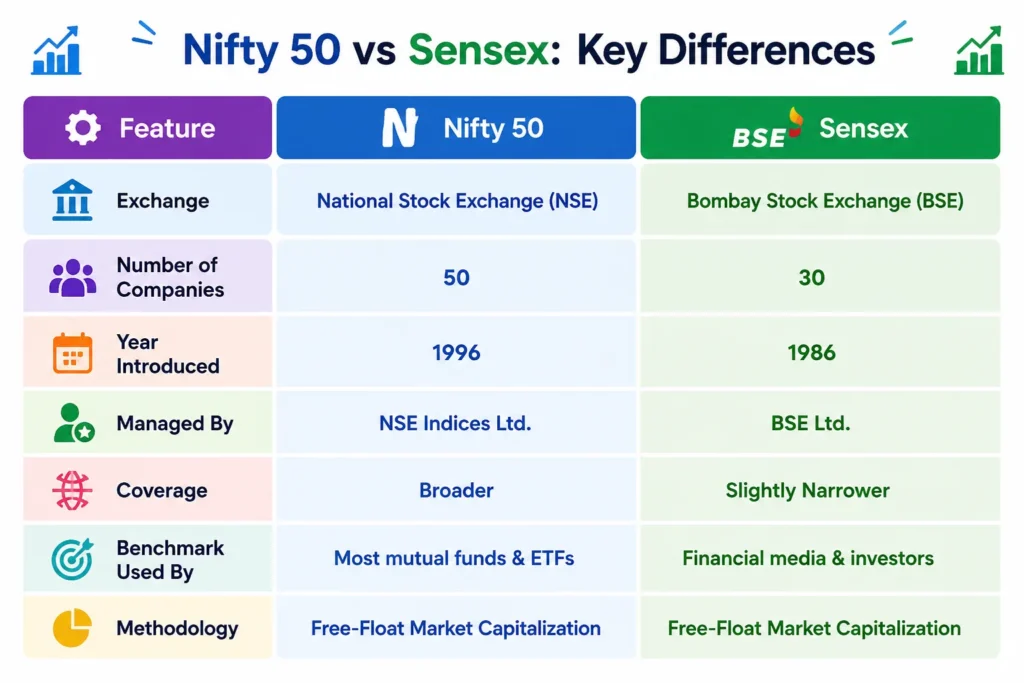
The Nifty 50 is India’s benchmark stock market index of the National Stock Exchange (NSE).
It tracks the performance of 50 of the largest and most liquid companies listed on the NSE.
These companies come from various sectors of the economy, making the index a broad representation of India’s corporate performance.
Major sectors included
- Banking
- Information Technology
- Financial Services
- FMCG
- Automobile
- Pharmaceuticals
- Oil & Gas
- Telecom
- Metals
- Infrastructure
The Nifty 50 accounts for a significant share of the free-float market capitalization of the NSE, making it one of the most widely followed indices in India.
Examples of Companies in Nifty 50
Some well-known companies include:
- Reliance Industries
- HDFC Bank
- ICICI Bank
- Infosys
- Tata Consultancy Services (TCS)
- Bharti Airtel
- Larsen & Toubro
- ITC
- Tata Motors
- Sun Pharmaceutical Industries
Note: The constituents of the Nifty 50 are reviewed periodically, so companies may be added or removed over time.
What Is Sensex?
The Sensex, officially known as the S&P BSE Sensex, is the benchmark index of the Bombay Stock Exchange (BSE).
It consists of 30 financially strong and well-established companies listed on the BSE.
Launched in 1986, Sensex is India’s oldest stock market index and is often considered the barometer of the Indian economy.
Although it tracks fewer companies than the Nifty 50, those companies represent a substantial portion of the Indian equity market.
Examples of Companies in Sensex
Some companies included are:
- Reliance Industries
- HDFC Bank
- ICICI Bank
- Infosys
- Tata Consultancy Services
- State Bank of India
- Axis Bank
- Mahindra & Mahindra
- Bajaj Finance
- Maruti Suzuki
Beta: What Is Beta in the Stock Market?
Beta (β) measures how much a stock’s price moves compared to the overall market (such as the Nifty 50 or Sensex). It helps investors understand a stock’s volatility or market risk.
- Beta = 1: The stock moves in line with the market.
- Beta > 1: The stock is more volatile than the market (higher risk).
- Beta < 1: The stock is less volatile than the market (lower risk).
- Beta < 0: The stock tends to move in the opposite direction of the market (rare).
Example:
If a stock has a Beta of 1.5 and the market rises by 10%, the stock is expected to rise by approximately 15%. If the market falls by 10%, the stock may decline by around 15%.
Remember: Beta measures a stock’s sensitivity to market movements, not whether it is a good or bad investment. It should always be considered alongside other fundamental and financial factors.
How Are Nifty and Sensex Calculated?
Both indices use the Free-Float Market Capitalization Method.
What does this mean?
The calculation considers only the shares that are available for public trading.
It excludes shares held by:
- Promoters
- Government (where applicable)
- Strategic investors
- Employee welfare trusts (in certain cases)
This methodology provides a more realistic picture of market movements because it reflects only the shares actively available to investors.
Formula
Free-Float Market Capitalization
Example:
If the combined current free-float market capitalization of all index companies is 25 times the base market capitalization and the base index value is 1,000, the index value will be:
In simple terms: As the free-float market value of the companies in the index increases or decreases, the Nifty 50 or Sensex rises or falls accordingly.

Why Do Nifty and Sensex Usually Move Together?
Many beginners wonder why both indices often rise or fall on the same day.
The reason is simple.
Several large companies are common to both indices.
For example:
- Reliance Industries
- HDFC Bank
- Infosys
- ICICI Bank
- TCS
When these heavyweight companies move significantly, they influence both indices.
Economic events such as:
- RBI monetary policy
- Inflation data
- Corporate earnings
- Global markets
- Foreign investor activity
also affect both indices simultaneously.
How about Investing Directly in Nifty or Sensex?
No, You can’t
Nifty and Sensex are indices, not individual stocks.
However, you can invest in products that replicate their performance.
These include:
- Index Mutual Funds
- Exchange Traded Funds (ETFs)
- Index Futures (for advanced investors)
- Index Options (for experienced traders)
For beginners, Index Mutual Funds and ETFs are generally the simplest ways to gain exposure to these indices.
Why Investors Track These Indices
Professional investors monitor Nifty and Sensex because they help in:
- Measuring overall market sentiment
- Comparing mutual fund performance
- Evaluating economic growth
- Tracking portfolio returns
- Identifying long-term market trends
Instead of checking hundreds of stocks, investors simply watch these indices to understand the market’s direction.
Example: Understanding Market Movement
Suppose today’s market closes as follows:
|
Index |
Yesterday |
Today |
|
Nifty 50 |
24,138 |
24,270 |
|
Sensex |
77,502 |
89,764 |
This generally indicates that large-cap stocks performed well during the trading session.
However, it does not mean every stock in India increased.
Some stocks may have fallen despite the overall market rising. It depends on the beta of the particular stock as explained above.
It also important to know the Common Myths About Nifty and Sensex
Myth 1: They Are Different Stock Markets
Reality:
Both track the Indian stock market but belong to different exchanges.
Myth 2: Higher Sensex Means Every Stock Is Rising
Reality:
Only the companies included in the index determine its movement.
Myth 3: Beginners Need Lakhs of Rupees to Invest
Reality:
Many index mutual funds allow SIPs starting from ₹100–₹500 per month, depending on the fund.
Myth 4: Nifty Always Performs Better Than Sensex
Reality:
Historically, both indices have delivered similar long-term trends because they track India’s leading companies.
Nifty 50 vs Sensex: Which Should You Follow?
If you’re:
A Beginner
Follow either index consistently to understand how the market behaves.
A Mutual Fund Investor
Nifty 50 is commonly used as the benchmark for large-cap funds.
A Long-Term Investor
Tracking both provides a broader understanding of market performance.
Frequently Asked Questions (FAQs)
Is Nifty better than Sensex?
Neither is universally better. Nifty 50 offers broader diversification with 50 companies, while Sensex tracks 30 established companies. Both are reliable market benchmarks.
Why does Sensex have only 30 companies?
Sensex was designed to represent India’s largest and most influential companies. These 30 companies collectively account for a substantial portion of the market’s value.
Can I buy Nifty or Sensex directly?
No. You cannot buy an index directly, but you can invest through index mutual funds or ETFs that track these indices.
Why do Nifty and Sensex fluctuate daily?
Their values change because the prices of the constituent companies move throughout the trading day based on demand, supply, company performance, and economic factors.
Which index is more popular?
Both are widely followed. Nifty 50 is more commonly used as a benchmark by mutual funds, while Sensex is frequently quoted in financial news and media.
Conclusion
Whether you’re investing for the first time or simply trying to understand stock market news, learning about Nifty 50 and Sensex is essential.
Both indices represent the performance of India’s leading companies and provide valuable insights into the overall direction of the market.
Instead of worrying about daily ups and downs, beginners should focus on understanding how these indices work, investing consistently, and building wealth with a long-term perspective.
Remember, Nifty 50 and Sensex are not investment products—they are indicators that help you make informed investment decisions.
Sources: