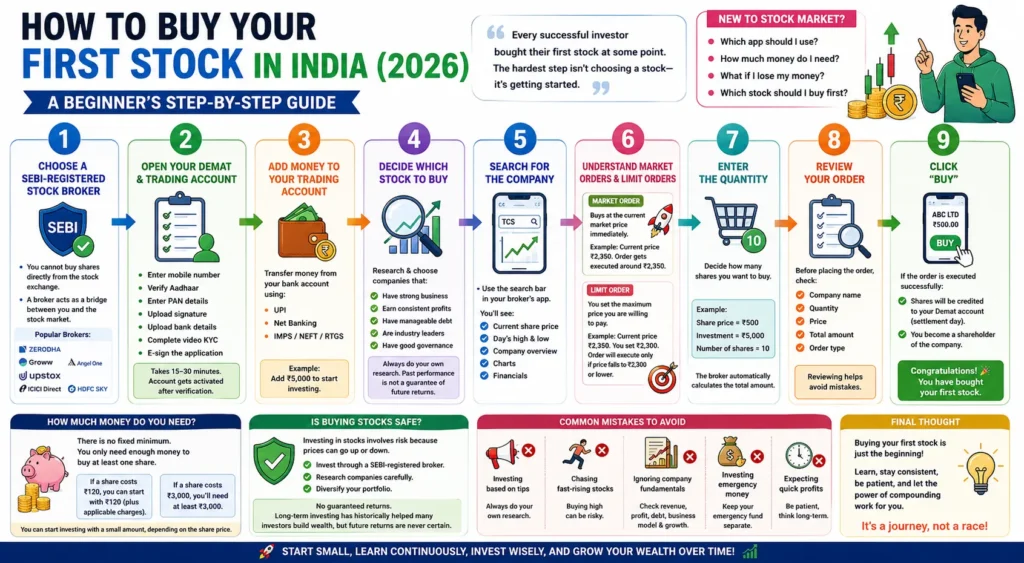
“Every successful investor bought their first stock at some point. The hardest step isn’t choosing a stock—it’s getting started.”
If you’re planning to invest in the Indian stock market for the first time, you might have several questions:
- Which app should I use?
- How much money do I need?
- What if I lose my money?
- Which stock should I buy first?
Don’t worry—you are not alone.
Buying your first stock may seem complicated initially, but once you understand the process, it is actually quite simple. In this guide, we’ll explain everything in easy language, even if you’ve never invested before.
What Does Buying a Stock Mean?
Before learning the process, let’s understand what a stock actually is.
A stock (also called a share or equity) represents ownership in a company.
When you buy one share of a company, you become one of its shareholders.
For example:
Imagine a company is divided into 10 lakh equal parts.
Each part is called a share.
If you buy one share, you own a tiny portion of that company.
As the company grows, your investment may also grow. Similarly, if the company performs poorly, the value of your investment may decrease.
That’s why stock investing involves both risk and reward.
Things You Need Before Buying Your First Stock
Before purchasing shares, you need a few essentials.
- PAN Card
A Permanent Account Number (PAN) is mandatory for investing in the Indian stock market.
- Aadhaar Card
Your Aadhaar helps complete your KYC verification quickly.
- Bank Account
You’ll need a bank account to:
- Add money to your trading account
- Receive dividends
- Withdraw funds after selling shares
- Mobile Number & Email ID
These are required for OTP verification and transaction alerts.
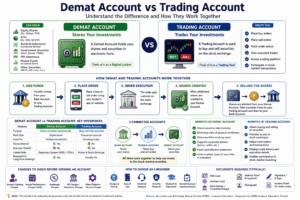
- Demat and Trading Account
This is the most important requirement.
A Demat Account stores your shares electronically.
A Trading Account allows you to buy and sell those shares.
Many brokers provide both accounts together.
Step 1: Choose a SEBI-Registered Stock Broker
You cannot buy shares directly from the stock exchange.
Instead, you need a stockbroker.
A stockbroker acts as a bridge between you and the stock market.
Some popular brokers in India include:
While choosing a broker, compare:
- Brokerage charges
- Annual Maintenance Charges (AMC)
- Ease of use
- Customer support
- Research tools
- Mobile app ratings
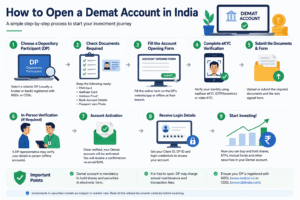
Step 2: Open Your Demat and Trading Account
Opening an account usually takes less than 15–30 minutes.
The process generally includes:
- Enter your mobile number
- Verify Aadhaar
- Enter PAN details
- Upload your signature
- Upload bank details
- Complete video KYC
- E-sign the application
Once verified, your account becomes active. Also for the detailed process Click Here
Step 3: Add Money to Your Trading Account
Before buying shares, transfer money from your bank account.
Most brokers allow instant transfers using:
- UPI
- Net Banking
- IMPS
- NEFT
- RTGS
Example:
Suppose you want to invest ₹5,000.
Simply add ₹5,000 to your trading account.
Step 4: Decide Which Stock to Buy
This is where many beginners make mistakes.
Instead of buying random stocks because someone recommended them, spend some time researching.
Look for companies that:
✔ Have a strong business
✔ Earn consistent profits
✔ Have manageable debt
✔ Are industry leaders
✔ Have good corporate governance
Examples include well-known companies with long operating histories across sectors such as banking, IT, FMCG, and energy. However, past performance does not guarantee future returns, so always do your own research before investing.
Step 5: Search for the Company
Open your broker’s app.
Use the search bar.
For example:
- Reliance Industries
- TCS
- Infosys
- HDFC Bank
Click on the company.
You’ll see:
- Current share price
- Day’s high and low
- Company overview
- Charts
- Financial information
Also you can see fundamental details of any of the company listed in Indian stock market on Screener
Step 6: Understand Market Orders and Limit Orders
Before purchasing shares, you’ll notice two options.
Market Order
A market order buys the stock immediately at the current market price.
Example:
Current price = ₹2,350
Your order gets executed around this price.
Suitable for beginners.
Limit Order
You decide the maximum price you’re willing to pay.
Example:
Current price = ₹2,350
You place a limit order at ₹2,300.
The order will only execute if the stock price falls to ₹2,300 or lower.
Useful when you don’t want to pay more than a certain amount.
Step 7: Enter the Quantity
Now decide how many shares you want to buy.
Example:
Share price = ₹500
Investment = ₹5,000
Number of shares = 10
The broker automatically calculates the total amount.
Step 8: Review Your Order
Before clicking Buy, check:
- Company name
- Quantity
- Price
- Total amount
- Order type
Reviewing your order helps avoid mistakes.
Step 9: Click "Buy"
Once you’re satisfied, click the Buy button.
If the order is executed successfully:
- The shares will be credited to your Demat account (typically on the settlement day).
- You officially become a shareholder of that company.
Congratulations! 🎉
You have bought your first stock.
Example: Buying Your First Stock
Let’s understand the process with an example.
Suppose:
Amount available = ₹10,000
You decide to buy shares of ABC Ltd.
Current share price = ₹500
You buy 20 shares.
Investment:
20 × ₹500 = ₹10,000
If the share price later increases to ₹600:
Value = ₹12,000
Profit = ₹2,000
If the price falls to ₹450:
Value = ₹9,000
Loss = ₹1,000
This is how profits and losses work in stock investing.
Should You Invest All Your Money in One Stock?
No.
One of the biggest mistakes beginners make is investing everything in a single company.
Instead, diversify.
For example:
Instead of investing ₹20,000 in one company,
consider spreading it across four or five companies from different sectors over time.
Diversification helps reduce overall risk.
Common Mistakes Beginners Should Avoid
Investing Based on Tips
Never buy stocks solely because a friend, relative, influencer, or social media post recommends them.
Always do your own research.
Chasing Fast-Rising Stocks
Many beginners buy stocks only after they have already risen sharply.
Buying simply because “everyone is buying” can be risky.
Ignoring Company Fundamentals
Look at the company’s:
- Revenue
- Profit
- Debt
- Business model
- Future growth potential
Strong fundamentals matter more than short-term price movements.
Investing Emergency Money
Only invest money that you won’t need in the near future.
Your emergency fund should remain separate from your investments.
Expecting Quick Profits
The stock market is not a get-rich-quick scheme.
Successful investing usually requires patience and a long-term perspective.
How Much Money Do You Need to Buy Your First Stock?
There is no fixed minimum amount.
You only need enough money to buy at least one share of the company you’re interested in.
For example:
- If a share costs ₹120, you can start with ₹120 (plus applicable charges).
- If it costs ₹3,000, you’ll need at least ₹3,000.
This means you can start investing with a relatively small amount, depending on the share price.
Is Buying Stocks Safe?
Investing in the stock market carries risk because share prices can go up or down.
However, investing through a SEBI-registered broker, researching companies carefully, and maintaining a diversified portfolio can help manage those risks.
Remember:
- There are no guaranteed returns.
- Long-term investing has historically helped many investors build wealth, but future performance is never certain.
Conclusion
Buying your first stock may feel intimidating, but the process is simpler than it appears. Once you have a Demat and Trading Account, the steps are straightforward: choose a trusted broker, add funds, research a company, place your order, and monitor your investment.
Don’t focus on finding the “perfect” stock. Instead, focus on learning how the market works, investing responsibly, and staying patient. Building wealth through the stock market is usually a gradual journey, not a race.
Frequently Asked Questions (FAQs)
- Can I buy shares without a Demat account?
No. A Demat account is required to hold shares electronically in India.
- What is the minimum amount required to buy stocks?
There is no fixed minimum. You only need enough money to purchase at least one share of the company.
- Can I lose all my money in stocks?
Yes, if a company performs extremely poorly or becomes worthless, your investment could lose significant value. Diversification and research can help reduce this risk, but they cannot eliminate it.
- Which is the best stock for beginners?
There is no universally “best” stock. Beginners should focus on understanding a company’s business, financial health, and long-term prospects instead of following recommendations blindly.
- Can I sell my shares anytime?
Yes. Shares listed on Indian stock exchanges can generally be sold during market hours, provided there are buyers in the market.