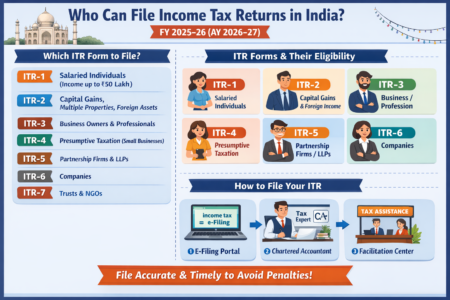
What You'll Learn
- Latest Income Tax Slabs for FY 2025-26
- Difference between New and Old Tax Regime
- Tax rebate under Section 87A
- Standard deduction
- Important ITR due dates
- Which tax regime is suitable for you?
Firstly lets Understanding Financial Year (FY) and Assessment Year (AY)
Financial Year (FY)
- Period in which you earn income.
- FY 2025-26 = 1 April 2025 – 31 March 2026
Assessment Year (AY)
- Year in which that income is assessed.
- AY 2026-27
Here are the few important dates to remember -Important ITR Due Dates
Category of Taxpayer | Due Date |
Individuals, Salaried Employees, HUFs, and other taxpayers not requiring audit | 31st July 2026 |
Businesses and professionals requiring audit under the Income-tax Act | 31 October 2026 |
Taxpayers required to furnish a Report under Section 92E (Transfer Pricing) | 30 November 2026 |
Updated Return (ITR-U) | Up to 48 months from the end of the relevant Assessment Year, subject to conditions under the Income-tax Act |
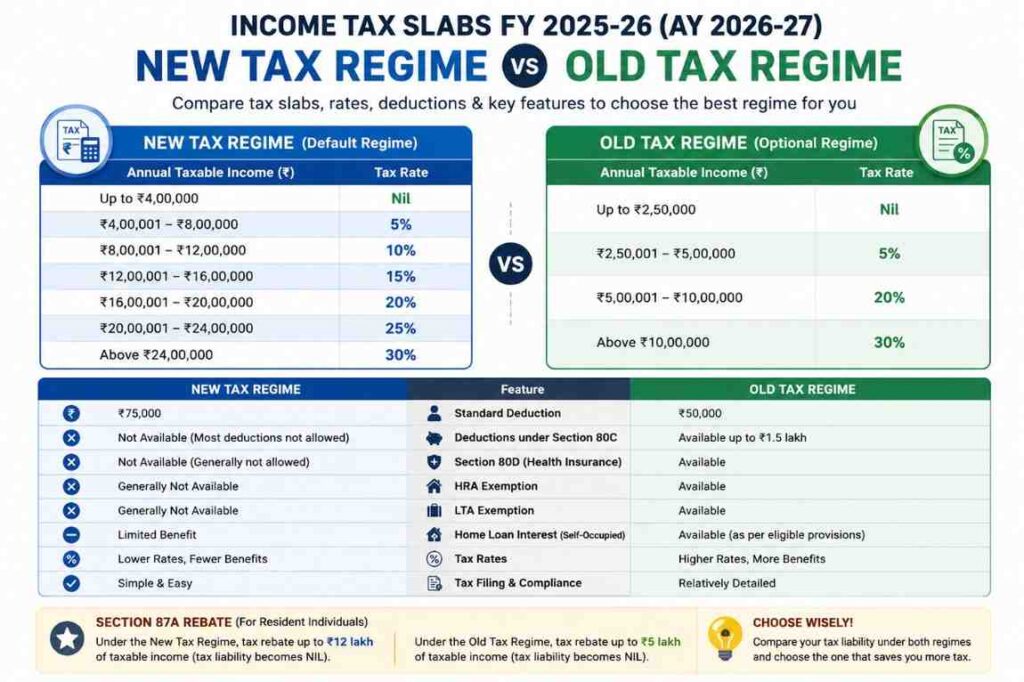
New Tax Regime vs Old Tax Regime: Key Differences
|
Feature |
New Tax Regime |
Old Tax Regime |
|
Default tax regime |
Yes |
No |
|
Tax rates |
Lower |
Higher |
|
Standard deduction |
₹75,000 |
₹50,000 |
|
Section 80C deduction |
Not available |
Available (up to ₹1.5 lakh) |
|
Section 80D deduction |
Generally not available |
Available |
|
HRA exemption |
Generally not available |
Available |
|
LTA exemption |
Generally not available |
Available |
|
Home loan interest (self-occupied house) |
Limited benefit |
Available under eligible provisions |
|
Number of deductions |
Very limited |
Many deductions available |
|
Tax calculation |
Simple |
More detailed |
New Tax Regime Slabs for FY 2025-26 (AY 2026-27)
The New Tax Regime is now the default tax regime for individual taxpayers. It offers lower tax rates but limits many deductions and exemptions available under the old regime.
|
Annual Taxable Income |
Tax Rate |
|
Up to ₹4,00,000 |
Nil |
|
₹4,00,001 – ₹8,00,000 |
5% |
|
₹8,00,001 – ₹12,00,000 |
10% |
|
₹12,00,001 – ₹16,00,000 |
15% |
|
₹16,00,001 – ₹20,00,000 |
20% |
|
₹20,00,001 – ₹24,00,000 |
25% |
|
Above ₹24,00,000 |
30% |
Key Features of the New Tax Regime
- Default tax regime for individuals.
- Standard deduction of ₹75,000 for salaried employees and pensioners.
- Most deductions and exemptions, such as Section 80C, Section 80D, HRA, and LTA, are generally not available.
- Simpler tax calculation with fewer compliance requirements.
- Eligible resident individuals may get a rebate under Section 87A that can reduce tax liability to zero on taxable income up to ₹12 lakh, subject to the applicable conditions.
Old Tax Regime Slabs for FY 2025-26 (AY 2026-27)
The Old Tax Regime continues to allow taxpayers to claim several deductions and exemptions that can reduce taxable income.
Individuals (Below 60 Years)
|
Annual Taxable Income |
Income Tax Rate |
|
Up to ₹2,50,000 |
Nil |
|
₹2,50,001 – ₹5,00,000 |
5% |
|
₹5,00,001 – ₹10,00,000 |
20% |
|
Above ₹10,00,000 |
30% |
Resident Senior Citizens (60–79 Years)
|
Annual Taxable Income |
Income Tax Rate |
|
Up to ₹3,00,000 |
Nil |
|
₹3,00,001 – ₹5,00,000 |
5% |
|
₹5,00,001 – ₹10,00,000 |
20% |
|
Above ₹10,00,000 |
30% |
Resident Super Senior Citizens (80 Years & Above)
|
Annual Taxable Income |
Income Tax Rate |
|
Up to ₹5,00,000 |
Nil |
|
₹5,00,001 – ₹10,00,000 |
20% |
|
Above ₹10,00,000 |
30% |
Rebate Under Section 87A
A tax rebate is a benefit provided by the government that reduces your income tax liability. In some cases, it can even reduce your tax payable to zero if your taxable income is within the prescribed limit.
Think of it as a discount on your income tax. The rebate is applied after your tax has been calculated, which means you pay less tax—or no tax at all if you qualify.
|
Tax Regime |
Eligible Taxable Income |
Maximum Rebate |
|
New Tax Regime |
Up to ₹12 lakh* |
₹60,000 |
|
Old Tax Regime |
Up to ₹5 lakh |
₹12,500 |
Health & Education Cess
- Charged at 4%
- Applied on:
- Income Tax
- Plus Surcharge (if applicable)
Surcharge Applicability (High Income Individuals)
|
Total Income |
Surcharge Rate |
|
Up to ₹50 lakh |
No Surcharge |
|
Above ₹50 lakh – ₹1 crore |
10% |
|
Above ₹1 crore – ₹2 crore |
15% |
|
Above ₹2 crore – ₹5 crore |
25% |
|
Above ₹5 crore |
37%* |
Important:
- Capital gains and dividend income have a maximum surcharge of 15%.
- Marginal relief is available to reduce the tax burden near surcharge thresholds.
Partnership Firms (Including LLPs)
- Flat income tax rate: 30%
- Surcharge: 12% if income exceeds ₹1 crore
- Health & Education Cess: 4%
Domestic Companies
Regular Tax Rates
- Eligible companies (turnover up to ₹400 crore): 25%
- Other domestic companies: 30%
|
Section |
TaxRate |
Who Can Opt? |
Key Condition |
|
Section 115BA |
25% |
Domestic manufacturing companies incorporated on or after 1 March 2016 |
Must satisfy specified conditions and forgo certain deductions and incentives. |
|
Section 115BAA |
22% |
Any eligible domestic company |
Must not claim specified exemptions or deductions. A 10% surcharge applies irrespective of income, and MAT is not applicable. |
|
Section 115BAB |
15% |
New domestic manufacturing companies incorporated on or after 1 October 2019 and commencing manufacturing within the prescribed time limit |
Must meet the prescribed conditions and cannot claim specified deductions or incentives. A 10% surcharge applies, and MAT is not applicable. |
Foreign Companies
- Royalty/technical services (eligible agreements): 50%
- Other income: 35%
- Health & Education Cess: 4%
- Surcharge applies based on income.
Co-operative Societies
Normal Tax Rates
- Up to ₹10,000 → 10%
- ₹10,001–₹20,000 → 20%
- Above ₹20,000 → 30%
Optional Tax Regimes
- Section 115BAD → 22%
Section 115BAE → 15% (for eligible manufacturing co-operative societies)
Which Tax Regime Should You Choose?
There is no single answer that works for everyone. The right choice depends on your income, investments, deductions, and financial goals.
Consider the New Tax Regime if:
- You do not claim many deductions.
- You prefer a simple tax filing process.
- You are a young professional with limited tax-saving investments.
- You do not receive HRA or other tax-exempt allowances.
Consider the Old Tax Regime if:
- You invest under Section 80C.
- You pay health insurance premiums and claim Section 80D.
- You claim HRA or home loan interest deductions.
- Your total eligible deductions significantly reduce your taxable income.
Frequently Asked Questions (FAQs)
- Can I switch between the New and Old Tax Regime?
Salaried individuals can generally choose the regime each financial year while filing their return, subject to the Income-tax Act rules. Individuals with business or professional income have different rules regarding switching.
- Is the New Tax Regime compulsory?
No. It is the default regime, but eligible taxpayers can opt for the Old Tax Regime if they satisfy the applicable conditions.
- Which regime is better?
It depends on your income level and the deductions you are eligible to claim. Comparing your tax liability under both regimes is the best approach.
- Does the New Tax Regime allow Section 80C deductions?
No. Most deductions under Section 80C are generally not available under the New Tax Regime.
- Which regime is easier to file?
The New Tax Regime is generally simpler because it has fewer deductions and exemptions.