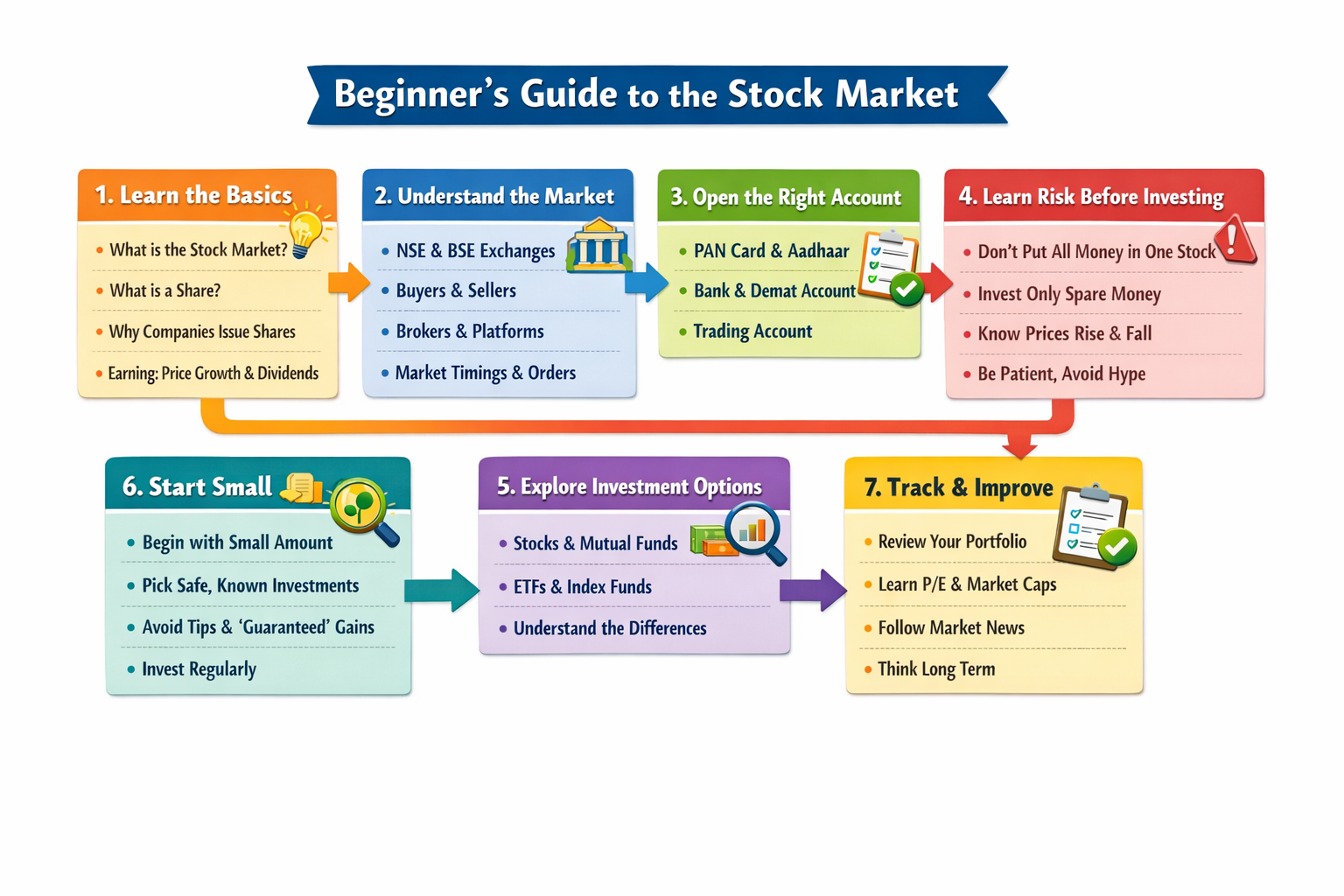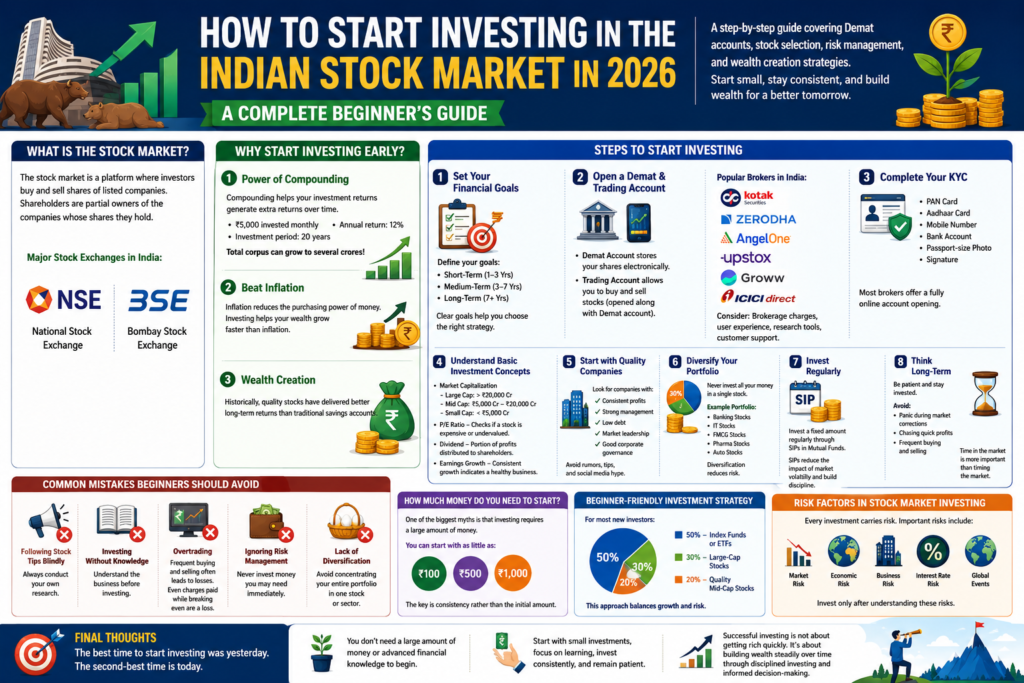
A step-by-step beginner’s guide covering Demat accounts, stock selection, risk management, and wealth creation strategies.
This is going to be a complete guide on how to invest in the stock market in 2026 after experiencing significant volatility over the past two years. We will discuss the steps involved, common mistakes to avoid, and practical tips to grow your wealth over time.
Let Me Give You a Brief Introduction to the Stock Market
The stock market is a platform where investors buy and sell shares of listed companies. Shareholders are considered partial owners of the companies whose shares they hold.
In India, there are two major stock exchanges:
- National Stock Exchange (NSE)
- Bombay Stock Exchange (BSE)
Major Points to Note
Why Should You Start Investing Early?
There are several advantages to investing early, including:
1. Power of Compounding
As Albert Einstein once said, “Compounding is the eighth wonder of the world.” It allows your investment returns to generate additional returns over time.
For example:
- ₹5,000 invested monthly
- Annual return: 12%
- Investment period: 20 years
The total corpus can grow to several crores due to the power of compounding.
You can even check this through the calculator provided right below.
Simple Interest & Standard Calculator
Use this interactive calculator:
I hope you understand the difference between simple and compound interest.
2. Beat Inflation
Inflation reduces the purchasing power of money. Investing helps your wealth grow faster than inflation. The current inflation rate of India is Approx. 3.93%
3. Wealth Creation
Historically, quality stocks have delivered better long-term returns than traditional savings accounts.
Now, let’s dive into the steps we need to follow to start investing.
Step 1: Set Your Financial Goals
Before investing, define your goals.
Examples:
Short-Term Goals (1–3 Years)
- Emergency fund
- Vacation planning
- Buying a gadget
Medium-Term Goals (3–7 Years)
- Car purchase
- Higher education
Long-Term Goals (7+ Years)
- House purchase
- Child’s education
- Retirement planning
Having clear goals helps you choose the right investment strategy.
Step 2: Open a Demat and Trading Account
To invest in stocks, you need:
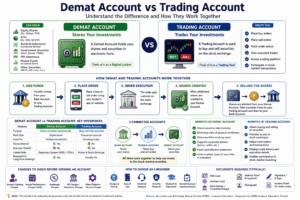
Demat Account
A Demat account stores your shares electronically.
Trading Account
A trading account allows you to buy and sell stocks. It is generally opened simultaneously during the process of opening a Demat account.
You can choose any of the popular brokers in India, such as:
While selecting a broker, consider:
- Brokerage charges
- User experience
- Research tools
- Customer support
Step 3: Complete Your KYC
To open an account, you will generally need:
- PAN Card
- Aadhaar Card
- Mobile Number
- Bank Account
- Passport-size Photograph
- Signature (a photograph of your signature on a blank sheet of paper for uploading)
Most brokers offer a fully online account-opening process.
Step 4: Understand Basic Investment Concepts
Before investing, learn the following:
Market Capitalization
- Large-Cap Stocks – Market capitalisation is usually above ₹20,000 crore.
- Mid-Cap Stocks – Market capitalisation is generally between ₹5,000 crore and ₹20,000 crore.
- Small-Cap Stocks – Market capitalisation is usually below ₹5,000 crore.
P/E Ratio
The Price-to-Earnings (P/E) ratio helps evaluate whether a stock is expensive or undervalued.
Dividend
A portion of a company’s profits is distributed to shareholders.
Earnings Growth
Consistent earnings growth often indicates a healthy business.
Step 5: Start with Quality Companies
Beginners should focus on fundamentally strong companies.
Look for companies that have:
- Consistent profits
- Strong management
- Low debt
- Market leadership
- Good corporate governance
Avoid investing based on rumors, tips, or social media hype.
Step 6: Diversify Your Portfolio
As the legendary investor Warren Buffett said, “Never put all your eggs in one basket.”
Never invest all your money in a single stock.
Diversification reduces risk.
Example Portfolio:
- Banking Stocks
- IT Stocks
- FMCG Stocks
- Pharma Stocks
- Auto Stocks
This helps protect your portfolio if one sector underperforms.
Step 7: Invest Regularly
Instead of trying to predict market movements, invest consistently.
SIP in Mutual Funds
Investing a fixed amount regularly.
For beginners, SIPs can be an excellent starting point because they reduce the impact of market volatility.
Step 8: Think Long-Term
Successful investing requires patience.
Many investors lose money because they:
- Panic during market corrections
- Chase quick profits
- Frequently buy and sell
Long-term investing allows quality companies time to grow and create wealth.
Common Mistakes Beginners Should Avoid
Following Stock Tips Blindly
Always conduct your own research.
Investing Without Knowledge
Understand the business before investing.
Overtrading
Frequent buying and selling often leads to losses. Even the brokerage and other charges paid while breaking even should be considered a loss.
Ignoring Risk Management
Never invest money that you may need immediately.
Lack of Diversification
Avoid concentrating your entire portfolio in one stock or sector.
How Much Money Do You Need to Start?
One of the biggest myths is that investing requires a large amount of money.
You can start with as little as:
- ₹100
- ₹500
- ₹1,000
The key is consistency rather than the initial amount.
Beginner-Friendly Investment Strategy
For most new investors:
- 50% – Index Funds or ETFs
- 30% – Large-Cap Stocks
- 20% – Quality Mid-Cap Stocks
This approach balances growth and risk.
Risk Factors in Stock Market Investing
Every investment carries risk.
Important risks include:
- Market Risk
- Economic Risk
- Business Risk
- Interest Rate Risk
- Global Events
Invest only after understanding these risks.
Conclusion
The best time to start investing was yesterday. The second-best time is today.
You do not need a large amount of money or advanced financial knowledge to begin. Start with small investments, focus on learning, invest consistently, and remain patient.
Remember, successful investing is not about getting rich quickly. It is about building wealth steadily over time through disciplined investing and informed decision-making.