If you are new to the Indian stock market, you have probably come across two important terms repeatedly:
- Demat Account
- Trading Account
Many beginners assume they are the same, but they actually serve different purposes in your investing journey.
In simple terms:
- A Demat Account stores your shares and securities electronically.
- A Trading Account helps you buy and sell those securities on the stock exchange.
Understanding the difference between these two accounts is essential before you start investing.
What You Will Learn in This Guide
✅ What a Demat Account is
✅ What a Trading Account is
✅ How they work together
✅ Key differences between them
✅ Whether you need both accounts
Note: This article is for educational purposes only and should not be considered investment advice.
What Is a Demat Account?
A Demat Account (short for Dematerialized Account) is an account that holds your financial securities in electronic form instead of physical certificates.
Think of it as a:
📦 Digital Locker for Your Investments
Instead of keeping paper share certificates, all your investments are stored securely in electronic form.
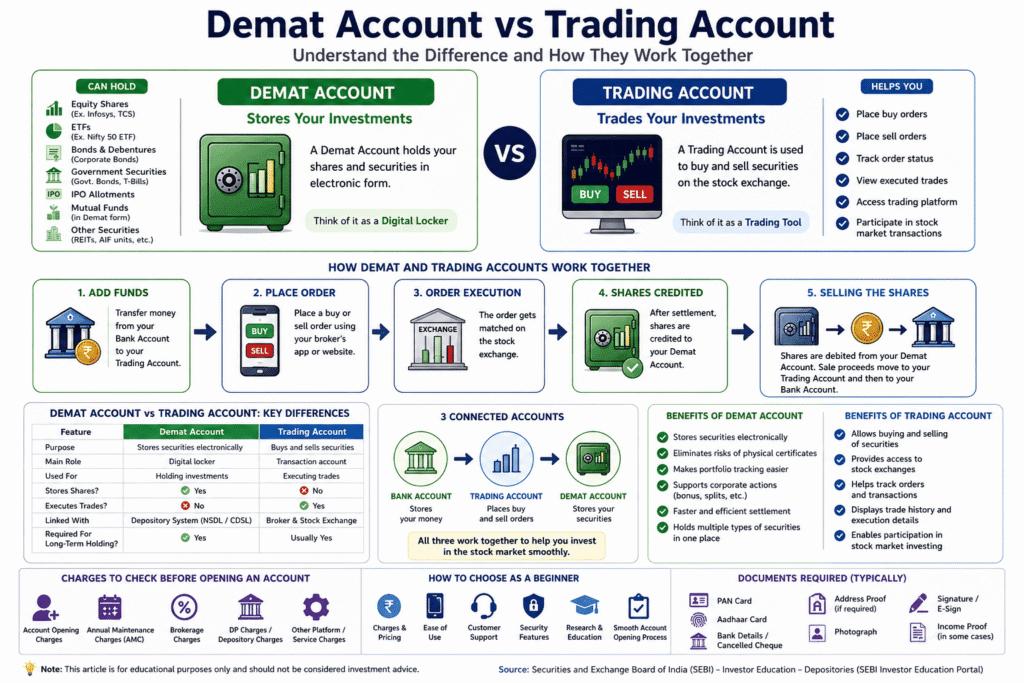
A Demat Account Can Hold:
- Equity Shares – Ex. Infosys, TCS, HDFC Bank
ETFs – Ex. Nifty 50 ETF, Gold ETF.
- Bonds and Debentures – Ex. Corporate Bonds, Company debentures
- Government Securities – Government Bonds, Treasury Bills
- IPO Allotments – Shares Allotted in an IPO
- Mutual Funds (in Demat form) – MF units held in Demat Account
- Other eligible market-linked securities – REITs, AIF units and other eligible securities
Simple Example
Imagine you buy 10 shares of Infosys.
1️⃣ You place a buy order through your broker.
2️⃣ The order gets executed on the stock exchange.
3️⃣ After settlement, the 10 shares are credited to your Demat Account.
Your Demat Account now safely stores those shares.
What Is a Trading Account?
A Trading Account is the account used to place buy and sell orders in the stock market.
It acts as a bridge between:
🏦 Your Bank Account
📈 Your Trading Account
📦 Your Demat Account
If the Demat Account is where your investments are stored, the Trading Account is the tool through which those investments are bought and sold.
What Does a Trading Account Do?
A Trading Account helps you:
✅ Place buy orders
✅ Place sell orders
✅ Track order status
✅ View executed trades
✅ Access your broker’s trading platform
✅ Participate in stock market transactions
Without a Trading Account, you generally cannot buy or sell listed shares through a broker.
Demat Account vs Trading Account: Key Differences
Feature | Demat Account | Trading Account |
Purpose | Stores securities electronically | Buys and sells securities |
Main Role | Digital locker | Transaction account |
Used For | Holding investments | Executing trades |
Stores Shares? | ✅ Yes | ❌ No |
Executes Trades? | ❌ No | ✅ Yes |
Linked With | Depository System | Broker & Stock Exchange |
Required For Long-Term Holding? | ✅ Yes | Usually Yes |
Easy Way to Remember
- Demat Account = Stores Shares
- Trading Account = Trades Shares
How Demat and Trading Accounts Work Together
The easiest way to understand this is through three connected accounts:
🏦 Bank Account → Stores your money
📈 Trading Account → Places buy and sell orders
📦 Demat Account → Stores your securities
Example:
Buying a Stock
Step 1: Add Funds
Transfer money from your Bank Account to your Trading Account.
Step 2: Place a Buy Order
Use your broker’s app or website to place a buy order.
Step 3: Order Execution
The order gets matched on the stock exchange.
Step 4: Shares Are Credited
After settlement, shares are credited to your Demat Account.
Step 5: Selling the Shares
When you sell:
- Shares are debited from your Demat Account
- Sale proceeds are transferred back through your broker and ultimately to your Bank Account
Do You Need Both Accounts?
For most investors in India, yes.
If you want to buy and sell listed shares through a stockbroker, you will generally need:
✅ A Demat Account
✅ A Trading Account
Why Both Are Needed
- Trading Account → Executes the transaction
- Demat Account → Stores the shares
Many brokers now offer 2-in-1 or 3-in-1 accounts, where you’re:
🏦 Bank Account
📈 Trading Account
📦 Demat Account
are linked together for convenience.
Although it may appear as a single account in the app, each account still performs a separate function.
Benefits of a Demat Account
✅ Stores securities electronically
✅ Eliminates risks associated with physical certificates
✅ Makes portfolio tracking easier
✅ Supports corporate actions such as bonus shares and stock splits
✅ Faster and more efficient settlement process
✅ Can hold multiple types of securities in one place
Benefits of a Trading Account
✅ Allows buying and selling of securities
✅ Provides access to stock exchanges
✅ Helps track orders and transactions
✅ Displays trade history and execution details
✅ Enables participation in stock market investing
Charges You Should Check Before Opening a Demat Account
One of the biggest mistakes beginners make is opening an account without understanding the cost structure. A “free account opening” offer does not always mean the account will be free to maintain or trade with.
Common charges to review
1) Account Opening Charges
Some brokers charge nothing, while others may charge a fee.
2) Annual Maintenance Charges (AMC)
This is one of the most important charges for a Demat account. Some brokers waive it for a period, while others charge it annually.
3) Brokerage Charges
These apply when you buy or sell through the trading account, depending on the segment and broker plan.
4) DP Charges / Depository Charges
These may apply especially on certain debit transactions from the Demat account.
5) Other platform or service charges
Depending on the broker, there may be additional charges related to statements, pledge requests, margin services, or premium tools.
Tip: Before opening an account, read the broker’s official pricing page carefully and compare the full fee structure, not just the headline “₹0 account opening” message.
How to Choose a Demat and Trading Account as a Beginner
If you are opening your first account, don’t choose a broker only because it is popular on social media or because someone shared a referral link. Compare the broker carefully.
Things to check before opening
1) Charges and pricing
Look at AMC, brokerage, DP charges, and any hidden fees.
2) Ease of use
A clean and beginner-friendly app or website can make a big difference when you are learning.
3) Customer support
This matters more than many beginners realise—especially when you face account, settlement, or login issues.
4) Security features
Check whether the platform supports strong authentication and secure account access.
5) Research and educational tools
Some brokers provide screeners, learning resources, webinars, and basic research support that can be useful for beginners.
6) Account opening process
A smoother KYC and onboarding process can save time, but don’t compromise on reliability just for speed.
What Documents Are Usually Required to Open a Demat and Trading Account in India?
The exact list may vary by broker, but commonly required documents include:
- PAN card
- Aadhaar card
- Bank account details / cancelled cheque / bank proof
- Address proof (if required separately)
- Photograph (depending on broker process)
- Signature / e-sign
- Income proof in some cases for certain segments or products
Most modern brokers in India allow online account opening with e-KYC and digital verification. Always check the latest account opening requirements directly with the broker or DP before applying.
Conclusion
A Demat Account and a Trading Account are closely connected, but they are not the same.
Remember This:
- Demat Account = Stores Your Investments
- Trading Account = Helps You Buy and Sell Investments
If you plan to invest in stocks in India, understanding how these two accounts work together is one of the first and most important steps toward becoming a confident investor.
Source: Securities and Exchange Board of India (SEBI). Investor Education – Depositories. Retrieved from the official SEBI Investor Education Portal.
This article has been prepared using information published by SEBI, NSDL, CDSL, and other publicly available regulatory resources to help ensure accuracy.